


| Hardware | |
|---|---|
| Components / other |
|
| Site Notice |
|---|
|
Nintendo Wiki has been upgraded! Please let site staff know if you see any errors. We also have a new domain: nintendowiki.net — please update links to use this new domain name. Thank you for editing! |
Joy-Con
Jump to navigation
Jump to search
| Joy-Con | ||||||||
|---|---|---|---|---|---|---|---|---|
| ||||||||
|
The Joy-Con (Joy-Con (L) and Joy-Con (R)) are the primary controllers for the Nintendo Switch. Their main feature is their versatility, able to be used as a singular controller both attached or detached from the Nintendo Switch itself and a controller grip, or as individual controllers.
Features and functionality
The Joy-Con are a pair of controllers that can be used as both a singular controller or as two controllers. The Joy-Con can be attached to the Joy-Con Grip (HAC-011) or the system by locking into the rails on both sides, or used independently from both by holding them in each hand.[1][2]
The controllers feature the same buttons in an asymmetrical layout. Each Joy-Con has an analog control stick that can be pressed, a set of "face buttons" (the standard A/B/X/Y buttons on Joy-Con R, and a set of d-pad buttons on Joy-Con L), and a digital shoulder button and trigger button on the back. The backs of the Joy-Con also feature buttons to remove the Joy-Con from the Nintendo Switch or Joy-Con Grip. On the tops are the plus (Joy-Con L) and minus (Joy-Con R) buttons. On the side are player indicator LEDs, a pair of additional "SL" and "SR" shoulder buttons when using the Joy-Con as individual controllers, and a sync button to connect the controllers to the console when held[1][3] that also acts as a power button when pressed.[4] A pair of Joy-Con Straps (HAC-014) can also be attached, which feature a wrist strap in addition to the SL and SR buttons and player LEDs.
Both Joy-Con have built-in accelerometers and gyroscopes for more advanced motion control.[1] Another new feature of the Joy-Con is "HD Rumble", a more advanced form of haptic feedback powered by Immersion Corporation's "LRA" (linear resonant actuator) technology, allowing users to feel more precise sensations.[1] Joy-Con L features a new Capture Button, which allows users to capture screenshots of gameplay by pressing the button or (as of version 4.0.0 system update and only in compatible software) capture video clips by holding the button down, which can be shared on social media.[1] Joy-Con R also has a built-in NFC reader and writer,[1] and its bottom is an IR camera which can detect the shapes of objects and their distance from the Joy-Con.[3][1]
The Joy-Con use a rechargeable lithium-ion battery (HAC-006[5]) which lasts for up to 20 hours at full charge. The Joy-Con can be charged by attaching them to the Nintendo Switch system (regardless of whether or not it is charging), or by using the Joy-Con Charging Grip (HAC-012).[1]
Gallery
-
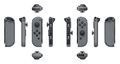 The Joy-Con viewed from various angles.
-
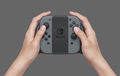 Holding the Joy-Con with the Joy-Con Grip.
-
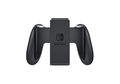 The Joy-Con Grip on its own.
-
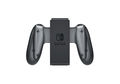 The Joy-Con Charging Grip.
-
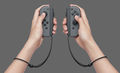 Holding the individual Joy-Con with the Joy-Con Straps.
-
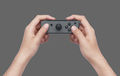 Holding the Joy-Con (R) individually.
-
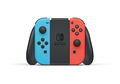 Neon Red and Neon Blue Joy-Con in the Joy-Con Grip.
-
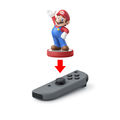 Using amiibo with the Joy-Con.
-
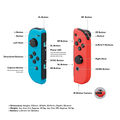 Diagram showing the buttons on the Joy-Con.
-
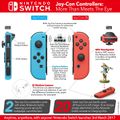 Infographic showing the various features of the Joy-Con.
-
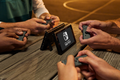 Using the Joy-Cons as individual controllers in local play between two Nintendo Switch consoles.
Trivia
- The name "Joy-Con" was derived from the word "enjoy".[6]
- An earlier iteration of the system used magnets to attach the Joy-Con for handheld mode, but this was changed to the rail design as the magnets would easily separate.[6]
- An early design for the Joy-Con Grip attached the controllers in a "V" shape. This was changed to the current, "parallel" design to make it easier to use.[6]
- Following the launch of the Nintendo Switch, a number of users reported issues regarding the left Joy-Con loosing connectivity when used wirelessly. According to Nintendo, the Joy-Con connectivity problems were the result of a "manufacturing variation", which has since been resolved.[7]
External links
References
- ↑ 1.0 1.1 1.2 1.3 1.4 1.5 1.6 1.7 Nintendo Switch Presentation 2017. Nintendo (Twitch; January 12, 2017). Retrieved May 11, 2019.
- ↑ First Look at Nintendo Switch. YouTube (Nintendo; October 20, 2016). Retrieved October 20, 2016.
- ↑ 3.0 3.1 Features on the official Nintendo Switch website. Retrieved January 13, 2017.
- ↑ Video: Nintendo Switch Controllers All Have a Power Button Hiding in Plain Sight. Nintendo Life (May 4, 2017). Retrieved May 5, 2017.
- ↑ Random Time! - User showcases the inside of a NIntendo Switch JoyCon. GoNintendo (February 28, 2017). Retrieved February 28, 2017.
- ↑ 6.0 6.1 6.2 5 Things You May Not Know About Nintendo Switch – Nintendo Minute Video. Nintendo (YouTube; February 24, 2017). Retrieved February 25, 2017.
- ↑ Nintendo Says JoyCon Wireless Issues Were Caused By 'Manufacturing Variation'. Kotaku (March 22, 2017). Retrieved March 24, 2017.
 | ||||||||
|---|---|---|---|---|---|---|---|---|
|